A visit to the ancient Lycian city of Olympos
The Land of Tombs
A visit to the ancient Lycian city of Olympos
There are other remains of ancient cities that are more impressive, extensive and in better states of preservation but few that have such a tranquil and beautiful setting. This deep, heavily wooded river valley, which opens into a wide bay at the southernmost edge of Asia Minor has There are other remains of ancient cities that are more impressive, extensive and in better states of preservation but few that have such a tranquil and an atmosphere and quality of light that would appeal to Poussin or other romantics.
I visited during the height of summer, walking along the beach from Çıralı village in the early morning to avoid the heat of the day when temperatures reach 40 degrees in the shade. Interestingly when the site was visited by Admiral Thomas Spratt and Sir Charles Fellows in the 1840’s, during their surveying and controversial acquisition (plundering even) of cultural and artistic remains, the site was known as Deliktaş (the Pierced Rock) which gave the only access along the beach. Riders would have to wade their horses through the sea to pass, in shades of Alexander’s march against the Persian cities. The rock arch was the height of a man and still exists but now can only be crawled through as the beach levels have risen considerably and also extend seawards.
A broad shingle bank now forms a bar at the river mouth and the water level must have been much higher in ancient times for the city to have functioned as a port. Even with higher water levels the function as a port must be questionable as it is only sheltered from west winds and an approach in a southerly or south easterly would have been very dangerous. Even as a roadstead it would have been untenable except when the wind was offshore.
Freya Stark in her book, The Lycian Shore, reports that her captain would only consider rounding the Chelidonian Cape and venturing north towards Antalya if it was confirmed that there would be northerly winds and a calm sea. She came ashore in a dinghy but apparently had to carry it across the shingle bank to enter the river so in 1952 the shore line must have been very similar to what we see today.
Link to interactive panorama
https://www.360cities.net/image/river-entrance-of-the-lycian-city-of-olympos#0.00,0.00,80.0
Walking up the river there are a number of impressive tombs in a good state of preservation, notably that of Eudomos, ( I assume the same who commanded the Rhodian fleet which defeated Hannibal at the battle of Eurymedon off modern Köprüçay ). A mosaic floor in the entrance to the tomb depicts a ship and another by the sarcophagus shows a warrior spearing a lion.
During the Roman period a bridge was built across the river but as this would have meant that any larger merchant vessels would have had to unstep their masts to pass under it I think that we can assume that by then that any function as a port had been greatly diminished. Perhaps lighters were used to transfer goods from shipping to the quayside?
Link to interactive panorama
https://www.360cities.net/image/the-river-and-quayside-of-the-lycian-city-of-olympos-antalys-turkiye#0.00,0.00,67.0
Walking up the valley and into the city you are stuck by the abundance of fresh water springs and pools and the luxuriant growth of trees and bushes. Indeed, when George E Bean visited in 1965 he described the site as ‘jungle’ and that no exploration should be made without a guide - nor was it suitable for the infirm!
Thankfully the conservators have removed large amounts of obstructive foliage while retaining enough to provide shade and enhance the bucolic atmosphere of the site. Visitors attention is soon drawn to the most striking remains of the entire site - a monumental gateway in the facade of a temple, still standing five to six metres high. Set in a wall of smooth masonry the lintels and uprights are finely decorated and this must have been an impressive building. Bean has a problem with the position of the building in that there is insufficient space behind the door due to the close proximity of a lake. He goes so far as to suggest that the entrance would have been on the opposite side and that the decoration was on the interior - contrary to usual practice. It should be remembered that when he visited it was still in the ‘jungle’ state so much less obvious to what we can now see!
Conservation work now places a number of column bases and drum sections of columns in a forecourt in front of the doorway so I think that there is no doubt that this must be the entrance. However this still raises questions as there is very little space beyond the doorway for a temple of the size that the magnificent entrance suggests. Bean has no answer to this nor Brian Sewell who visited in the mid 70’s during a journey recounted in his very entertaining book, South from Ephesus, where he suggests that the foundations were drowned with a rise in sea level - rather contrary to the evidence that the quayside is now well above the water level.
My own theory is that the lake (now little more than a marsh) was itself the centre of the sacred site and the subject of devotion. The doorway was a portal to the sacred site but did not have a temple to enclose it. We know that rivers and lakes are frequently associated with sacred rites and that offerings were made to gods and spirits of water. I wonder if any excavation or investigation has taken place in that location? Obviously the siting of the city was very dependent on the abundance of water and the dangerous coast would also have given rise to offerings of thanks for safe passages. I did notice that there were a number of people collecting water in bottles from one of the springs and others bathing in the pools. This was not just getting the sand off your feet after the beach but a full immersion - and I wondered if this was some forgotten ritual associated with a sacred lake? - mere speculation on my part!
Link to interactive panorama of the temple doorway
https://www.360cities.net/image/the-monumental-doorway-of-the-roman-temple-olympos-turkiye#312.26,-1.82,81.1
Link to interactive panorama of the temple forecourt and statue base with a dedication to the Emperor Marcus Aurelius
https://www.360cities.net/image/the-pronaos-of-the-roman-temple-at-the-ancient-city-of-olympos-lycia-turkiye#0.00,0.00,80.0
Much of what we can now see is later in date and evidence of the length of time that the city was occupied by a changing populace. Early Christian churches and alters are found along with Byzantine remains but it is a wonderful place to explore.
Link to interactive panorama of the Byzantine ruins
https://www.360cities.net/image/byzantine-ruins-of-the-ancient-lycian-city-of-olympos-cirali-turkiye#0.00,0.00,80.0
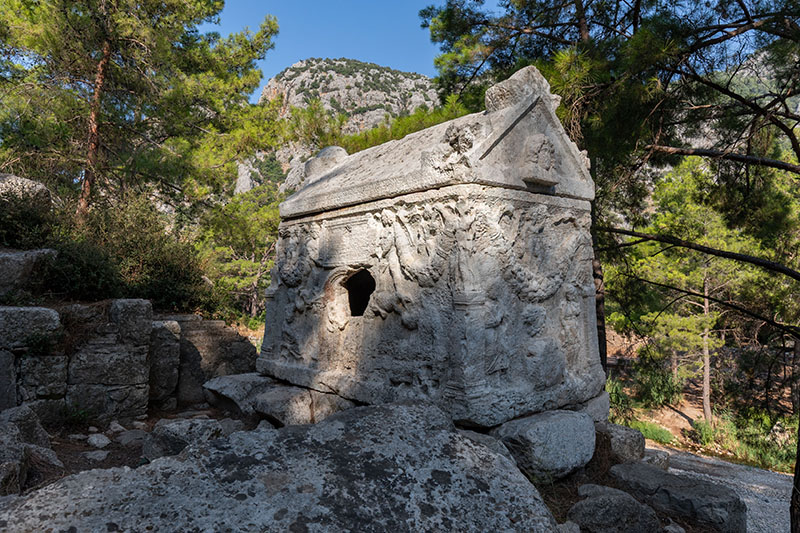
There are a number of necropolis’ on the site where the cities dead were buried and honoured. Some of the tomb are finally decorated but all robbed in antiquity.
Link to interactive panorama of tombs in the northern necropolis
https://www.360cities.net/image/lycian-tombs-in-the-ancient-city-of-olympos-cirali-turkiye#0.00,0.00,89.9
On the western bank of the river close to the quayside area is a stretch of walling of coursed polygonal masonry that Bean uses to judge the date of the construction of the Hellenistic city to before 300BC. This leads to the theatre which is in a very poor state of preservation - apart from one of the entrance tunnels which gives an idea of the quality of the original construction. There is also a necropolis on the steep slopes rising from the river with a number of finely decorated tombs. The Sarcophagus of Alkestis is a particularly fine example.
References :-
Turkey’s Southern Shore - George E Bean. Essential reading for all who are interested in the archaeology of Türkiye. Although these were written in the 70’s they are still fresh with a mix of historical references and description and mapping of individual sites. He wrote a further three books -
Aegean Turkey
Turkey beyond the Maeander
Lycian Turkey
South From Ephesus - Brian Sewell. Sewell’s journey in 1975 from Ephesus to Side. Amusing and insightful and one of my favourites of travel writing.
The Lycian Shore - A Turkish Odyssey - Freya Stark. Stark and friends sailed in a small boat along the coast of Türkiye in 1952 visiting many ancient sites.